Login
Login
 MSTA Regions
 Search
 Contact Us
.png) 800-392-0532
800-392-0532

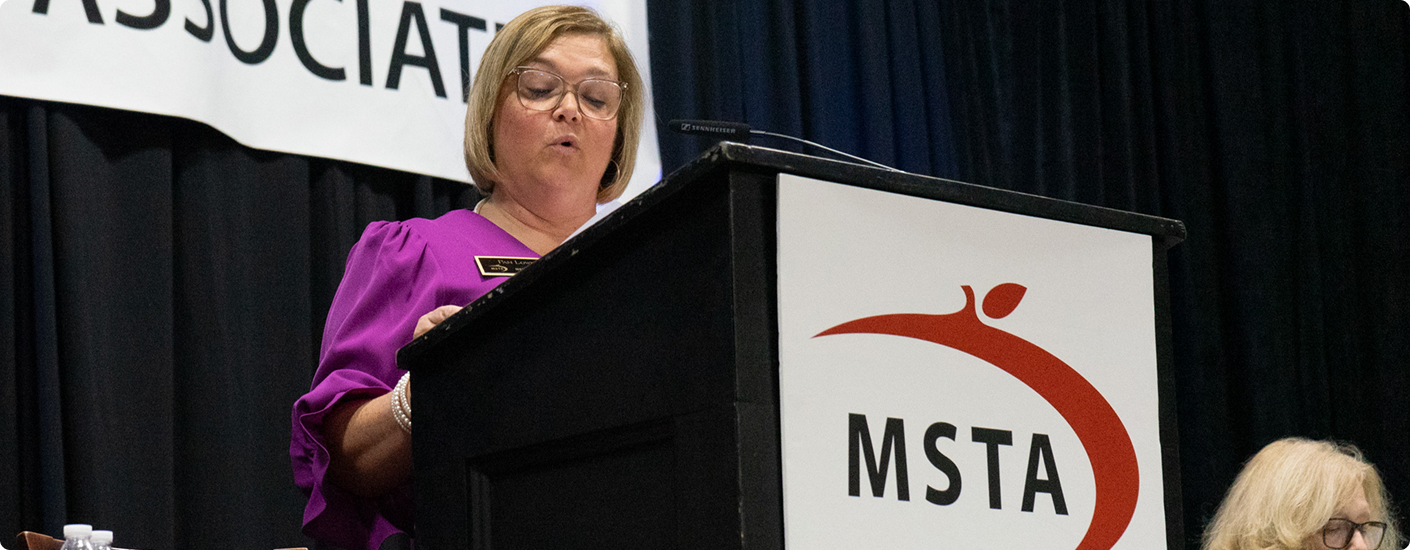




MSTA raises concerns as Missouri moves forward with A–F school grades
The State Board of Education approved implementation of the Missouri Department of Elementary and Secondary Education’s proposed A–F School and District Grading Framework, developed in response to Gov. Mike Kehoe’s Executive Order 26-01.
The approval allows DESE to prepare 2024–25 school-year data, develop a technical guide, and establish a timeframe for piloting the framework. DESE told the State Board that it will conduct a pilot before grades are released publicly.
The framework would assign letter grades to public schools and districts based on academic achievement, value-added growth, growth toward proficiency, success-ready graduate indicators, and graduation rates.
During the board’s discussion, members questioned how the framework accounts for the effect of poverty on student outcomes and whether it should be piloted before being implemented statewide. DESE officials said the framework’s growth measures are intended to recognize improvement regardless of a student’s economic status, background, or starting point on the proficiency scale.
The board’s action followed a Sept. 10 feedback session attended by MSTA Education Policy staff. During that session, staff questioned DESE officials about the framework’s timeline, methodology, and expectations.
Jocelyn Strand, assistant commissioner for the Office of Quality Schools, provided an overview of DESE’s response to the executive order. The presentation covered the framework’s initial design and the data that could be used to calculate grades.
Although the framework incorporates several measures, it continues to rely heavily on high-stakes test results. Significant questions also remain about how the measures will be calculated, weighted, and communicated to the public.
Why MSTA opposes A–F school grading systems:
-
A–F grades change labels, not learning. A single letter may seem simple, but it obscures important information about student growth, subgroup performance and the underlying causes of challenges. Missouri already collects detailed school-performance data. Reducing it to one letter diminishes understanding rather than improving it.
-
Public grading creates pressure without providing support. Meaningful school improvement requires time, resources and stability. Branding schools with a “D” or “F” can contribute to staff turnover, declining enrollment and instability—the very conditions that make improvement more difficult.
-
Missouri already has accountability and flexibility. The state’s current improvement-based model holds districts accountable while providing detailed, actionable information. Federal law does not require A–F grades, and several states have reconsidered these systems after experiencing unintended consequences.
MSTA continues to oppose this misguided policy. During the legislative session, MSTA testified against unsuccessful legislation that would have placed the governor’s proposal into law. Although lawmakers did not approve that legislation, the State Board of Education is moving forward with the plan through the executive-order process.
Testimony
News coverage
- Jan. 29: Bill would tie teacher bonuses to A-F school rating system pushed by Kehoe, St. Louis Post-Dispatch. Quotes MSTA Government Liaison Mike Harris, who testified that the system would hold educators responsible for factors outside their control.
- March 27: Missouri governor’s A-F school grading plan faces bipartisan Senate opposition, WGEM. Quotes MSTA Education Policy Director Matt Michelson arguing that a test-heavy system does not provide a complete picture of what schools face.
- July 6: Missouri teachers push back on governor's A-F school grading plan, KY3. Quotes Michelson's concerns for starting this process amid a funding shortage when the real priority should be fully funding schools.
- Aug. 20: Missouri school districts to get “first look” at new A-F grading system this fall, ABC 17. Quotes Michelson on the pressure to teach to the test and the stigma associated with being labeled an A or F school.
- Aug. 20: Simple or oversimplified? Missouri prepares to grade schools on an A-to-F scale, The Beacon. The most detailed coverage of MSTA’s position. Michelson discusses oversimplification, confusion, costs, the emphasis on one annual test, and the potential effect on innovation.
- Aug. 24: Missouri’s A–F school grading framework heads to state board for approval, KSHB 41. Quotes Michelson on the problems created by making school ratings dependent on one grade and one test score.
- Sept. 10: Missouri districts could see 2025 data tied to A–F grading plan by end of September, ABC 17. Quotes Michelson on states moving away from single letter grades in favor of more complete performance dashboards and the unresolved questions surrounding Missouri’s framework.
MSTA Action coverage
- Jan. 30: MSTA testifies in opposition to the A–F accountability bill
- Feb. 13: House committee advances HB 2710
- Feb. 27: Senate A–F bill moves to the full Senate
- March 6: House passes HB 2710; MSTA remains opposed
- March 27: MSTA testifies against HB 2710 in the Senate
- April 3: Senate committee advances the A–F bill
- April 24: A–F provisions are added to an omnibus bill
- May 1: A–F legislation remains a possibility late in the session
- May 8: MSTA reiterates its opposition as HB 2710 remains in the Senate