 Login
 MSTA Regions
 Search
 Contact Us
 800-392-0532




Please make sure your MSTA membership is renewed for the 2026–27 school year so you can continue receiving important education policy updates, advocacy opportunities, and information affecting your profession.

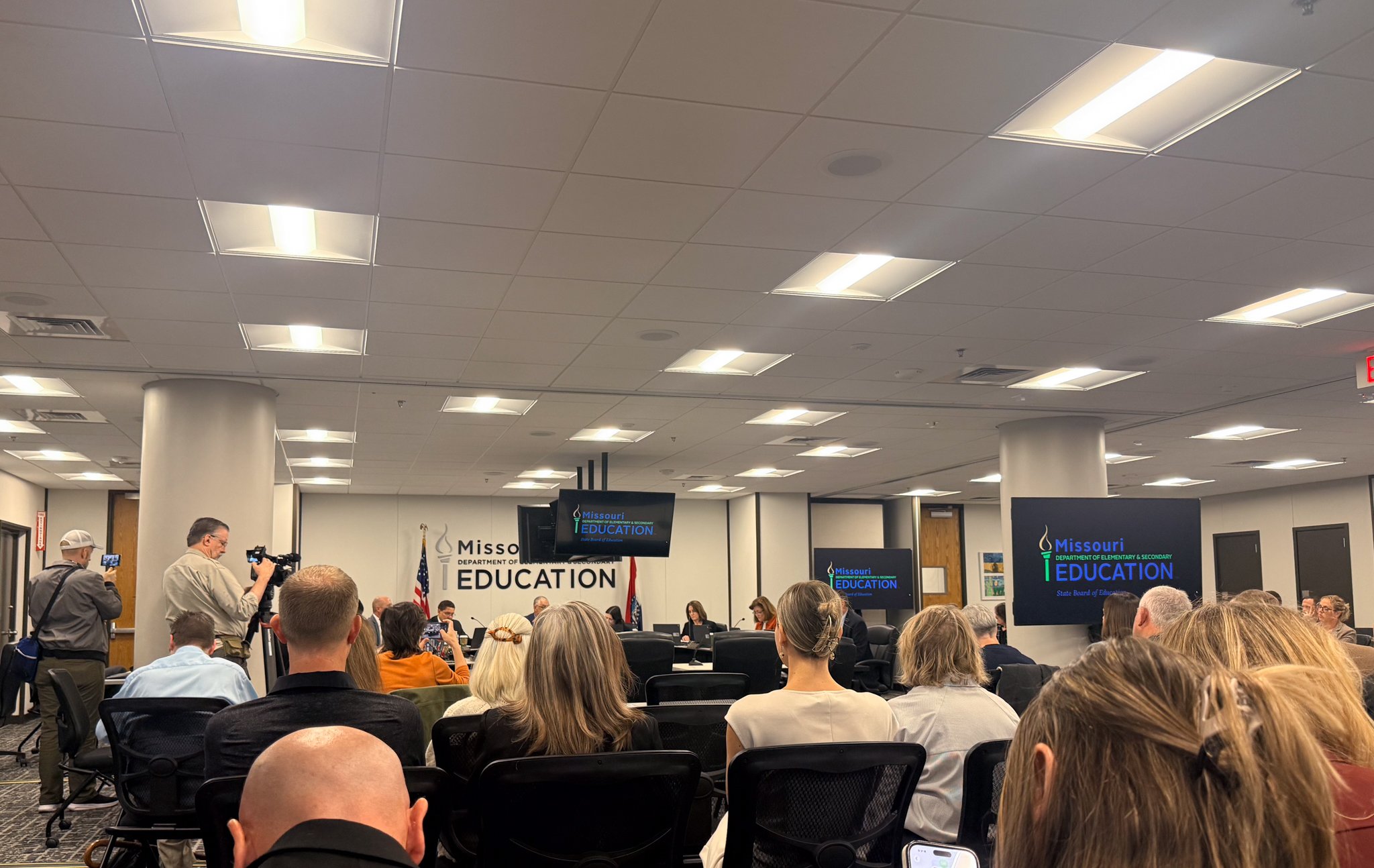
People gather at the Missouri State Board of Education meeting on Tuesday, Oct. 20, 2026, in Jefferson City.
Preis out: political turmoil continues on State Board
Dysfunction and political interference have become troubling hallmarks of the Missouri State Board of Education. The board, constitutionally designed to provide stability, oversight, and leadership for Missouri's public schools, continued to find itself with a leadership problem.
Despite publicly praising Interim Commissioner Dr. Stacey Preis as recently as June, the State Board accepted Preis' resignation on Tuesday. Preis briefly spoke after her resignation at the meeting.
In reference to the A-F report card, she mentioned, “Labels and scores do not improve schools. Meaningful improvement comes from identifying what schools need, providing effective support, and directing our time and resources toward strategies that make a difference for students.”
Addressing educators and education associations, Pries said, "You bring tremendous knowledge, ability, and integrity to your work, and your voices are essential in shaping the future of public education in our state."
The consequences of the State Board's instability extend well beyond the boardroom. Abrupt leadership changes and questions about political influence could discourage highly qualified candidates from pursuing the commissioner position. Missouri needs an experienced, respected education leader capable of building trust among educators, school leaders, policymakers, and communities.
Missouri's next Commissioner of Education should be selected based on demonstrated qualifications, experience, and the ability to lead public education, not political connections or allegiances.
The State Board has not named a new interim commissioner. MSTA will continue monitoring developments surrounding the State Board and the commissioner selection process. We will advocate for transparency, accountability, and leadership that puts Missouri's students, educators, and public schools first.
Make your voice heard: Missouri's next Commissioner of Education
The process for selecting Missouri's next Commissioner of Education has raised significant concerns about transparency and public participation.
The State Board previously approved a contract with the National Association of State Boards of Education (NASBE) to assist with the search for a new commissioner. At Tuesday's meeting, the State Board voted to hire K12Search Group to assist in the search, a group with strong ties to charter school operators and state charter school associations, and has worked to fill positions in charter schools in both Kansas City and St. Louis.
MSTA believes that classroom educators must have a meaningful voice in selecting the individual who will lead Missouri's public education system.
The next commissioner will play a critical role in decisions affecting school accountability, educator certification, academic standards, school funding, and the day-to-day work of Missouri's educators.
EducationPlus is conducting a survey to gather input regarding the qualities, experience, and priorities Missouri should seek in its next commissioner. MSTA encourages members to participate and share their perspectives. The survey is open through this Friday, Oct. 23, 2026.
Complete the EducationPlus Commissioner Survey here.
Please note that survey findings may be publicly reported in aggregate form and attributed by geographic region, county, or respondent role.
Survey results will be compiled and shared with the Department of Elementary and Secondary Education and the State Board of Education.
A–F school letter grades: MSTA continues to raise concerns
The State Board of Education is moving forward with developing a system that would assign A–F letter grades to Missouri's public school buildings and districts. The proposed grades are based on data from the 2024–25 school year and rely heavily on statewide student assessments. On Tuesday, the Board advised DESE to release draft data under embargo to school districts. The board will also release a draft technical guide to the public to provide information about what the scores actually mean.
While accountability and transparency are important, assigning schools a letter grade oversimplifies school performance and fails to adequately recognize the many factors that influence student achievement. A single letter grade cannot fully reflect the dedication of educators, the progress students make, or the unique challenges and opportunities facing individual school communities.
MSTA believes meaningful school accountability should provide parents, educators, and communities with accurate, comprehensive information that supports continuous improvement—not simply label schools.
The Missouri General Assembly has repeatedly considered and rejected proposals to implement A–F school grading systems. MSTA remains concerned about the continued pursuit of this approach outside the legislative process.
School Funding Modernization Task Force cancels meeting
The Missouri School Funding Modernization Task Force, established by Gov. Mike Kehoe through an executive order earlier this year, canceled its previously scheduled Oct. 19 meeting.
The task force was charged with examining Missouri's foundation formula and developing recommendations to modernize how the state funds its public schools.
With only one remaining meeting scheduled for Nov. 16 in Jefferson City and a final report due Dec. 1, significant questions remain about the group's ability to provide adequate public review of its recommendations.
Of particular concern is the lack of publicly available simulations showing how the funding models under consideration would affect individual school districts. Changes to Missouri's foundation formula could have significant financial consequences for school districts, educators, students, and local taxpayers.
Without detailed district-level simulations, educators, school leaders, and communities have limited opportunities to evaluate the potential impact of proposed changes before recommendations are finalized. Education stakeholders cannot adequately evaluate a new school funding formula without understanding which districts would gain funding, which could lose funding, and how those changes would affect students.
Voting begins in Missouri: make your voice heard
Missouri voters will soon begin casting ballots in the Nov. 3, 2026, General Election. No-excuse absentee voting begins Tuesday, Oct. 20, and continues through 5 p.m. on Monday, Nov. 2.
Find voting information through the Missouri Secretary of State’s website.
Decisions made by elected officials have a direct impact on Missouri's public schools, including school funding, educator retirement, certification requirements, and policies affecting classrooms.
MSTA encourages all members to participate in the election and become informed about candidates seeking to represent their community.
Before casting your ballot, take time to review the candidates endorsed by the MSTA Legislative Impact Committee.
View the 2026 MSTA Impact Endorsed Candidates here.
The MSTA Legislative Impact Committee works to identify and support candidates for the Missouri General Assembly who demonstrate a commitment to public education. Endorsed candidates have either voted in support of substantial pro-public education legislation or have filled out surveys and participated in interviews detailing their future support for public schools
MSTA recognizes that members hold diverse political views and may not support every candidate endorsed by the committee. The goal of the endorsement process is not to tell members how to vote, but to provide information about candidates' positions and records on education issues.

